
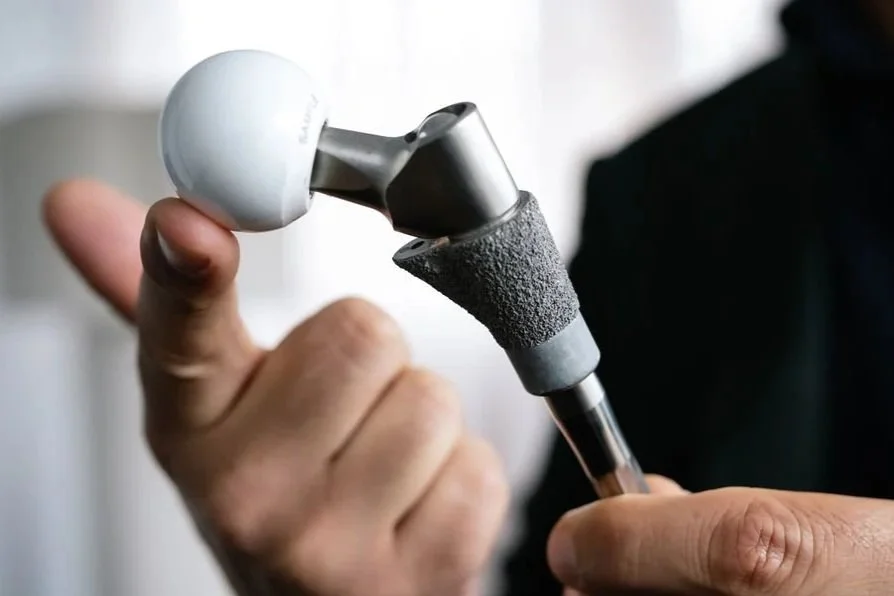
Total Hip Replacement
*
Total Hip Replacement *
Considered care for hip arthritis and joint damage, guided by a senior orthopaedic specialist with over 30 years of clinical experience.
Hip pain that limits the things you love doing, sleep that’s broken by aching joints, stiffness that makes getting up from a chair feel like you’ve run a marathon. These are the everyday signs that your hip may need more than conservative management.
If you’ve reached that point, Dr Elie Khoury offers a careful, evidence-based approach to total hip replacement. With fellowship training at the Nuffield Orthopaedic Centre in Oxford and three decades of clinical practice, he focuses on what’s actually right for you, not what’s quickest or most convenient.
What Is A Total Hip Replacement?
A total hip replacement (also called a total hip arthroplasty) is one of the most successful operations in modern medicine. It involves removing the damaged surfaces of the hip joint and replacing them with prosthetic components that restore smooth, pain-free movement.
The hip is a ball-and-socket joint. When the cartilage that cushions that joint wears down (most often from osteoarthritis), the bones grind against each other. The result is pain, stiffness, and a steady loss of mobility.
In a total hip replacement, both parts of the joint are replaced: with an artificial ball and socket joint made of the latest materials known to wear well and are proven to be highly successful in joint replacement surgery.
Done well, the result is a joint that moves freely, holds up for decades, and lets you get back to walking, working, sleeping and living without your hip dictating the terms.

When is a Hip Replacement Recommended?
Hip replacement is almost never a first option. Dr Khoury takes a conservative approach to surgical recommendations, meaning surgery is considered only after non-surgical treatments have been properly trialled.
You may be a candidate for total hip replacement if you have persistent hip pain that hasn’t responded to physiotherapy, medication, weight management or activity modification; your sleep is regularly disturbed by hip pain; everyday activities (walking, climbing stairs, putting on shoes and socks, getting in and out of a car) have become difficult or painful; you experience hip pain at rest, not just during activity; imaging shows advanced joint damage from osteoarthritis, rheumatoid arthritis, post-traumatic arthritis, avascular necrosis, or hip dysplasia; or your quality of life has been meaningfully reduced and conservative options have been exhausted.
Dr Khoury’s view is that timing matters. Operating too early means outliving the implant and potentially facing revision surgery later. Waiting too long can make recovery harder and leave permanent limitations. The right time is something he’ll work through with you carefully at your consultation.
Frequently Asked Questions
-
Modern hip replacements are expected to last 20 years or more in most patients. Longevity depends on activity level, implant choice, weight, and quality of surgery.
-
Not necessarily. Some patients have arthritis affecting only one hip. Others have both hips affected and may eventually need both done, typically as separate operations.
-
Most patients return to driving around 6 weeks after surgery, subject to Dr Khoury's clearance and your own confidence behind the wheel.
-
Many patients return to low-impact activities like walking, swimming, cycling, golf and doubles tennis. High-impact sports (running, contact sports) are generally not recommended, as they shorten implant life. Dr Khoury will discuss what's realistic for your goals.
-
Yes. To see Dr Khoury, a referral from your GP is required, which you can also request from your GP. Once you have it, our rooms will help you book a consultation that suits you.
-
Dr Khoury consults at three locations:
St Kilda Road Melbourne
the Mornington Peninsula at The Bays Hospital
Albury at the Gardens Specialist Centre.
Our team will help you find the most convenient location.
Dr Khoury’s Approach to Hip Replacement
Choosing to have a hip replacement is a significant decision, and one that deserves a careful, considered conversation with a senior specialist. Dr Khoury and his team are here to walk you through it without pressure, with the time you need to ask questions, understand your options, and feel confident about what's right for you.
A hip replacement is not a single, standard procedure. There are different surgical approaches, different implants, different recovery protocols. The right combination depends on your anatomy, your lifestyle, your goals, and what the evidence actually supports.
To book, you'll need a referral from your GP. If you don't have one yet, your GP can refer you directly to Dr Khoury at any of our three locations.